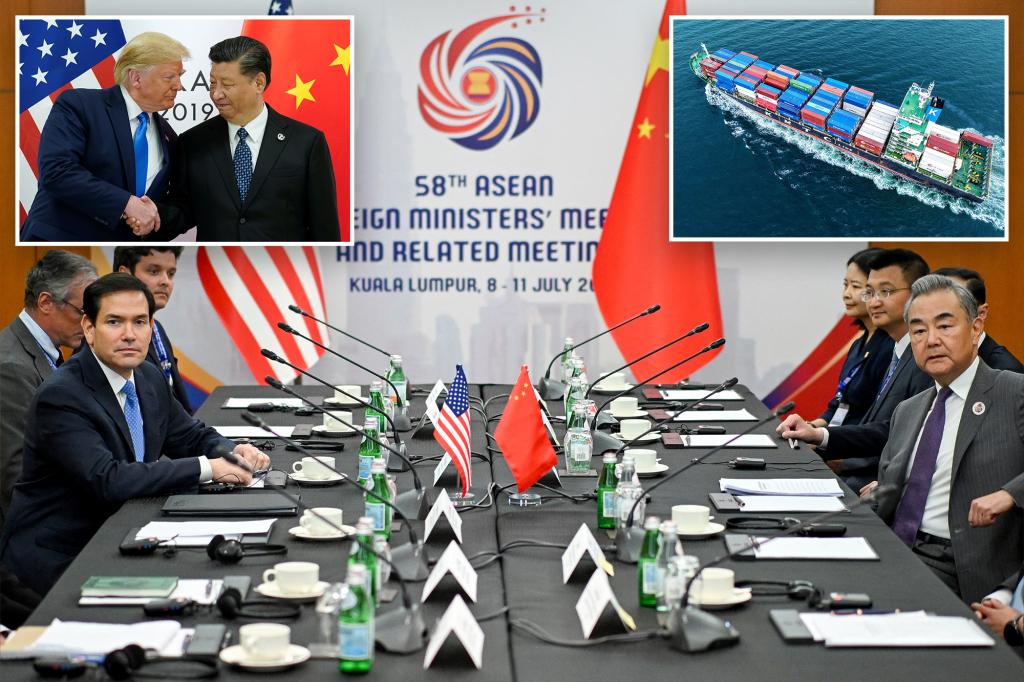
Rubio Meets China’s Foreign Minister Amid Rising US-China Tensions
U.S. and China Engage in High-Stakes Southeast Asian Meeting
The U.S. Secretary of State, Marco Rubio, concluded his second day at a Southeast Asian security summit with a significant face-to-face discussion with China’s Foreign Minister, Wang Yi. The meeting took place amid rising tensions between Washington and Beijing over trade, security, and China’s backing of Russia’s invasion of Ukraine.
Rubio’s trip included talks with regional nations at the ASEAN forum in Malaysia, culminating in his first direct encounter with Wang. The leaders did not speak to the press during their photo session. The discussions occurred shortly after Rubio met with Russian Foreign Minister Sergey Lavrov to explore avenues for initiating peace talks in Ukraine.
The broader context surrounds global concerns over U.S. policies. While U.S. officials face complaints about tariffs, Rubio emphasized that security issues, particularly concerns over Chinese influence, remain central to their interactions. Rubio noted a positive response from many Southeast Asian countries regarding U.S. cooperation despite tensions over trade tariffs, which U.S. President Donald Trump threatened to escalate.
China counters U.S. claims, with Wang accusing the U.S. of damaging global trade stability through tariffs and asserting that these measures hinder development. He stressed China’s desire to be a reliable partner to nations like Cambodia and to promote regional stability. Wang and Lavrov also issued subtle warnings to the U.S. about regional tensions, emphasizing support for ASEAN’s central role in maintaining peace in the Asia-Pacific.
During the summit, Rubio highlighted cooperation efforts, including a civil nuclear agreement with Malaysia, while China sought to portray itself as a balancing power in regional discussions. Australian Foreign Minister Penny Wong expressed that ongoing U.S. engagement was vital for regional stability, advocating for a balanced power dynamic free from dominance or coercion.

Both nations expressed support for regional stability, though underlying tensions persist over trade, security, and influence. The dialogue underscores ongoing geopolitical balancing in the region amid complex U.S.-China dynamics.