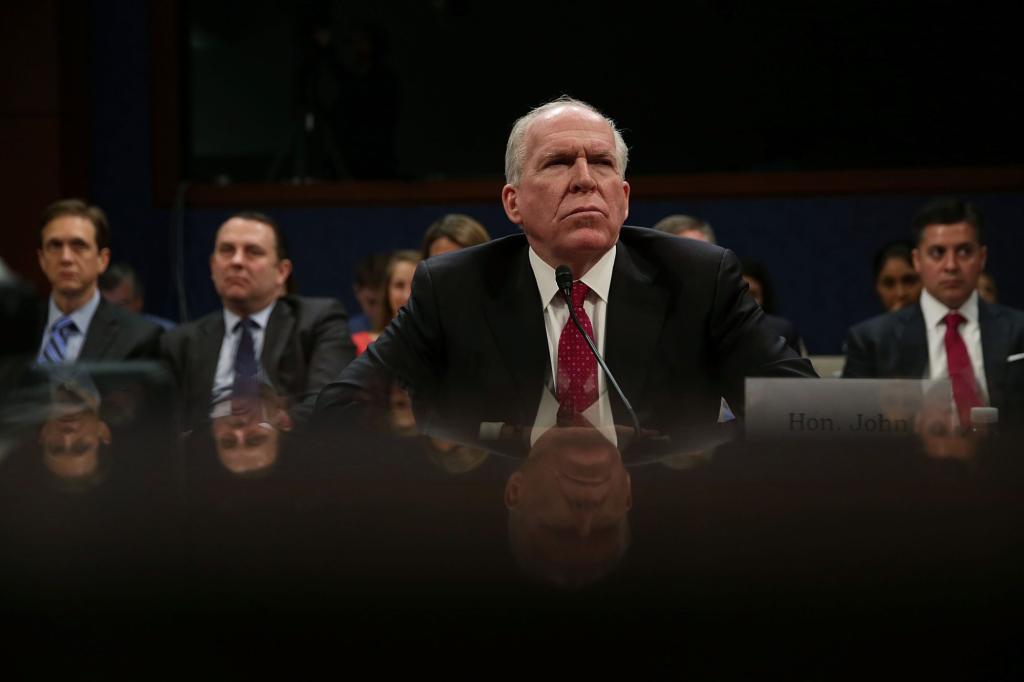
Ex-CIA Chief Brennan at Risk of Perjury Over Trump-Russia Hoax, Says Miranda Devine
Internal Review Reveals Brennan’s Role in Including Discredited Steele Dossier in Trump-Russia Assessment
A recently declassified CIA review suggests that former CIA Director John Brennan may have committed perjury by misrepresenting his involvement in the agency’s 2016 Trump-Russia intelligence assessment. The review exposes critical flaws in how Brennan pushed for the inclusion of the Steele dossier—a document riddled with false claims—in the report ordered by President Obama.
The report indicates Brennan was more influenced by the dossier’s supposed alignment with existing theories than by solid intelligence standards. Despite warnings from CIA Russia experts and Deputy Director for Analysis David Cohen, Brennan insisted in writing that the dossier’s information warranted inclusion, even though its credibility was widely questioned within the agency.

The Steele dossier, funded by Hillary Clinton’s campaign and authored by former British spy Christopher Steele, was a tawdry opposition research piece filled with falsehoods, including the absurd claim that Trump paid prostitutes to urinate on a Moscow hotel bed. An independent review by John Durham concluded that the FBI could not verify any allegations from the dossier.
The CIA review criticizes Brennan for embedding the dossier into the final assessment, contradicting fundamental tradecraft principles and damaging its credibility. The dossier was inserted both in an annex and referenced in the core judgment that claimed Putin sought to help Trump win, influencing major investigations and political narratives.
Former FBI Director James Comey also pushed for the dossier’s inclusion, making it central to the intelligence community’s findings. However, Brennan publicly denied its role, claiming in 2017 that the dossier was not part of the intelligence used for the assessment—an assertion now proven false.
Despite this, Brennan continued to present himself as uninvolved, claiming he only learned about the dossier in late summer 2016. These revelations cast new light on the uncertified, biased origins of the Russia collusion narrative that dominated early Trump administration years.