JWST Spots Dusty Red Supergiant Before Supernova Explosion
James Webb Space Telescope Captures First Supernova Progenitor
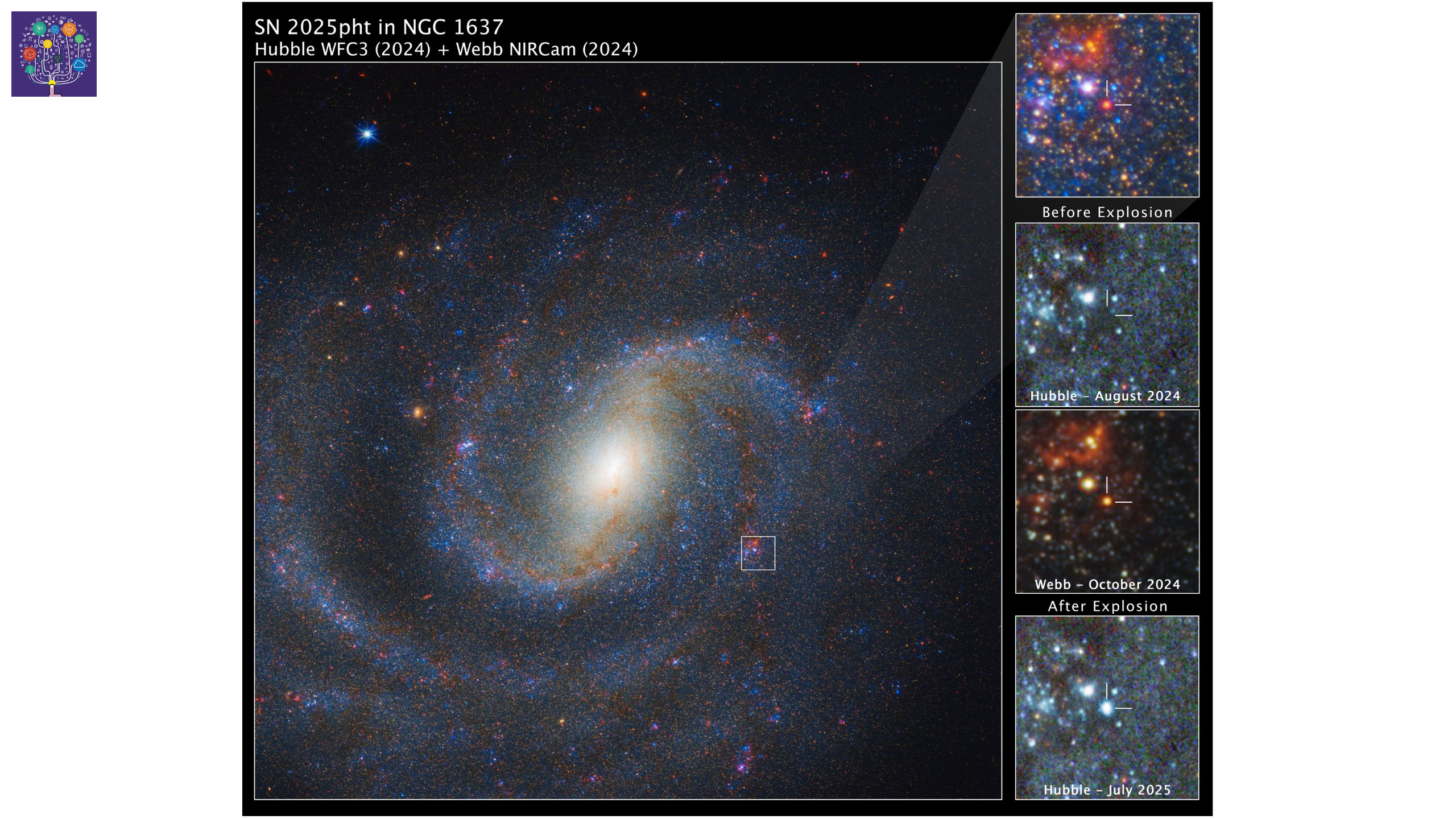
For years, astronomers have searched for massive red supergiant stars that are predicted to end their lives in spectacular supernova explosions, but direct observations of these precursors have been scarce. Now, with the advanced infrared capabilities of the James Webb Space Telescope (JWST), researchers have achieved their most detailed view yet of a red supergiant before it exploded.
The team identified the star responsible for the supernova SN 2025pht, located in a galaxy approximately 40 million light-years away. This discovery is significant, as it marks the first confirmation of a supernova progenitor using JWST. By analyzing images taken both before and after the explosion—some from Hubble dating back to 1994 and recent JWST observations—they accurately matched the star to the explosion, confirming its identity as the progenitor.
Before the explosion, the star appeared extremely bright and red, shrouded by thick dust that dimmed its visible light by over 100 times, despite shining roughly 100,000 times brighter than our Sun. This dense dust cocoon explains why such stars have been hard to observe with traditional telescopes. The findings suggest many red supergiants may be hidden behind similar dust layers, causing gaps in prior detections.
“This is the reddest, dustiest red supergiant we’ve seen explode,” said co-author Aswin Suresh. “Previous supernovae might have been more luminous than we realized, thanks to the infrared data now available.”
Stars like SN 2025pht represent the final evolutionary stage of massive stars—called red supergiants—whose cores collapse to produce supernovae, ultimately leaving behind neutron stars or black holes. Notably, the surrounding dust was unusually rich in carbon, hinting at internal processes that dredged up carbon during the star’s last years.
This breakthrough enhances understanding of stellar life cycles and demonstrates the power of JWST and future telescopes like the Nancy Grace Roman Space Telescope. Astronomers now anticipate observing many more hidden supernova progenitors in their final moments, revolutionizing the study of stellar explosions.