Will Comet C/2025 A6 Lemmon Be Visible to the Naked Eye? | Space
New Comet C/2025 A6 (Lemmon) Approaching the Inner Solar System
In the upcoming weeks, skywatchers will have the chance to observe a newly discovered comet traveling toward the sun. As it approaches, the comet is expected to brighten and may become visible without optical aid in dark sky conditions—possibly even with the naked eye for those in remote, light-pollution-free areas.
The comet, formally named C/2025 A6 (Lemmon), was identified by the Mount Lemmon Survey using a powerful 60-inch telescope at the Mount Lemmon Observatory in Arizona. The survey primarily detects near-Earth objects like asteroids, but occasionally captures new comets, as with Lemmon.
Initially mistaken for a dim star, follow-up images confirmed it as a comet. Its orbit indicates it will reach perihelion—the closest point to the sun—on November 8, at a distance of approximately 49 million miles. It will come closest to Earth on October 20, at about 55 million miles away. This orbit has been refined through observations since November 2024.
Historical and Orbital Details
Comet Lemmon has an estimated orbital period of roughly 1,350 years. Notably, it passed close to Jupiter in April, which altered its orbit, shortening its cycle by around 200 years. Its farthest point from the sun, at about 22.6 billion miles, places it on its long journey through the solar system.
What Causes Comet Brightness?
Comets are primarily composed of frozen gases that heat and glow as they near the sun, forming a luminous head or coma. Expanding gases carry dust particles into space, creating a tail. The appearance varies, with some comets showing long, bright tails, while others appear as a dense cloud.
Visibility Predictions
Forecasts vary on how bright Comet Lemmon will become. Some experts project it may reach magnitude +4 to +5, making it visible to the naked eye under dark skies in early October. Conservative estimates suggest it will peak around magnitude +7.3, visible through binoculars or small telescopes.
Viewing Opportunities
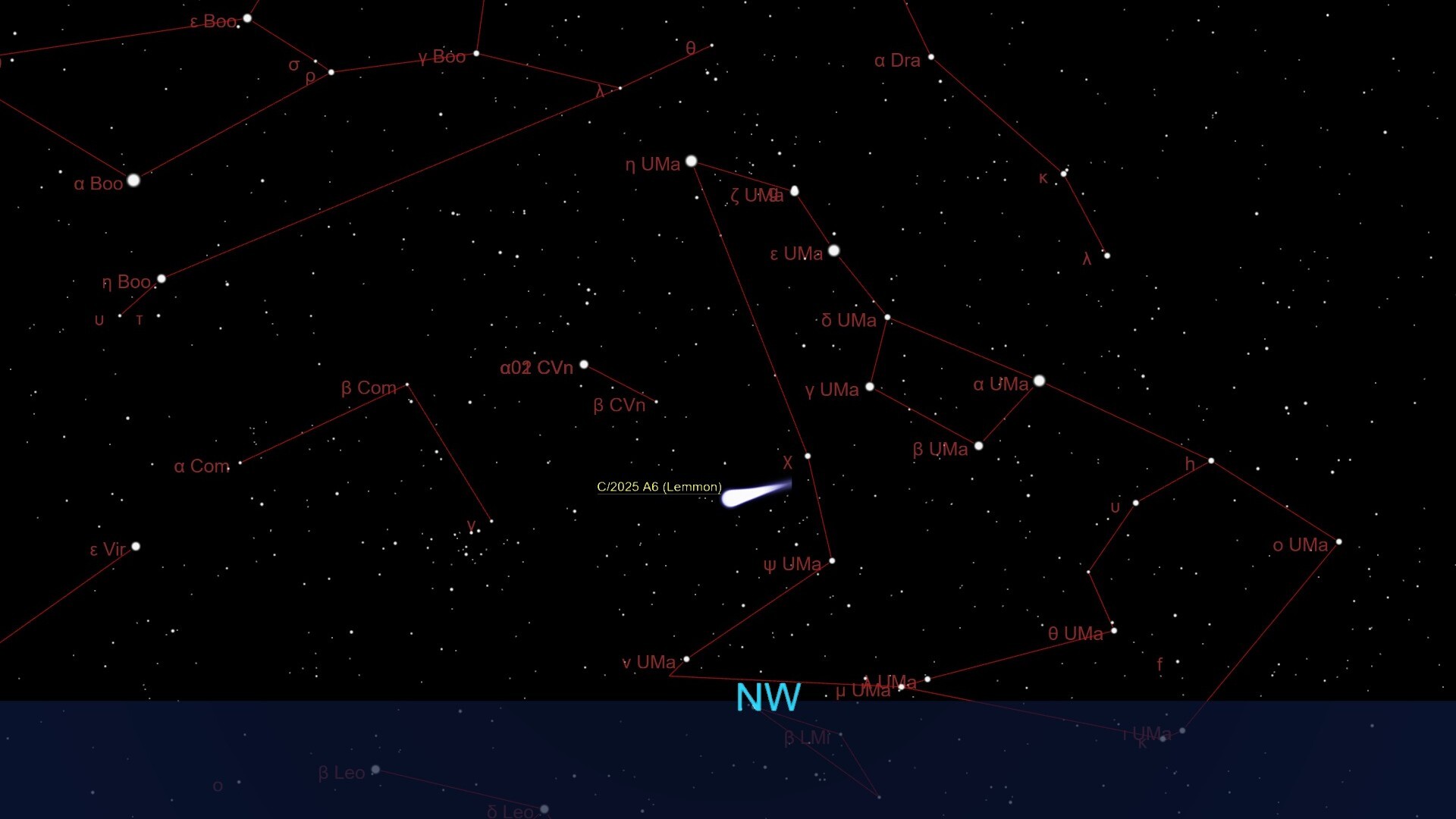
Currently, the comet is visible before sunrise in the constellation Cancer. It will move into Lynx in early September and increase in brightness as it approaches Earth. By October 6, it will be visible in the southern sky near the star Tania Australis and later in the northwest after sunset.
Additional Tips for Observers
While dark skies offer the best viewing conditions, comet Lemmon may be visible with binoculars or telescopes from locations with minimal light pollution. Its tail is expected to be mostly gas, appearing faint with a bluish hue, and the comet itself may resemble a bright, rounded cloud with a condensed center. Some observers might detect a faint, elongated tail. Keep in mind that comets are unpredictable; they could surprise us with unexpected brightness or remain faint. Stay tuned for updates on its visibility.