Cannibal Solar Storm May Ignite Labor Day Northern Lights
Imminent Solar Storm May Bring Vibrant Auroras
A significant solar storm is approaching Earth, potentially lighting up the skies with spectacular northern lights just in time for the upcoming holiday weekend.
On August 30, a powerful M2.7 solar flare erupted from sunspot Active Region 4199, propelling a fast-moving coronal mass ejection (CME) directly toward Earth. The NOAA Space Weather Prediction Center forecasts that this CME will arrive late on September 1 or early September 2 (UTC).
Modeling indicates a moderate G2 (strong) geomagnetic storm upon initial impact, intensifying to G3 (major) as the storm peaks, possibly allowing auroras to be seen farther south across parts of the northern United States.
Space weather expert Tamitha Skov notes that two Earth-directed solar storms are headed our way, with one potentially catching up to the other—a phenomenon known as a “cannibal CME.” This interaction could amplify geomagnetic disturbances before the larger storm arrives, expected late on September 1.
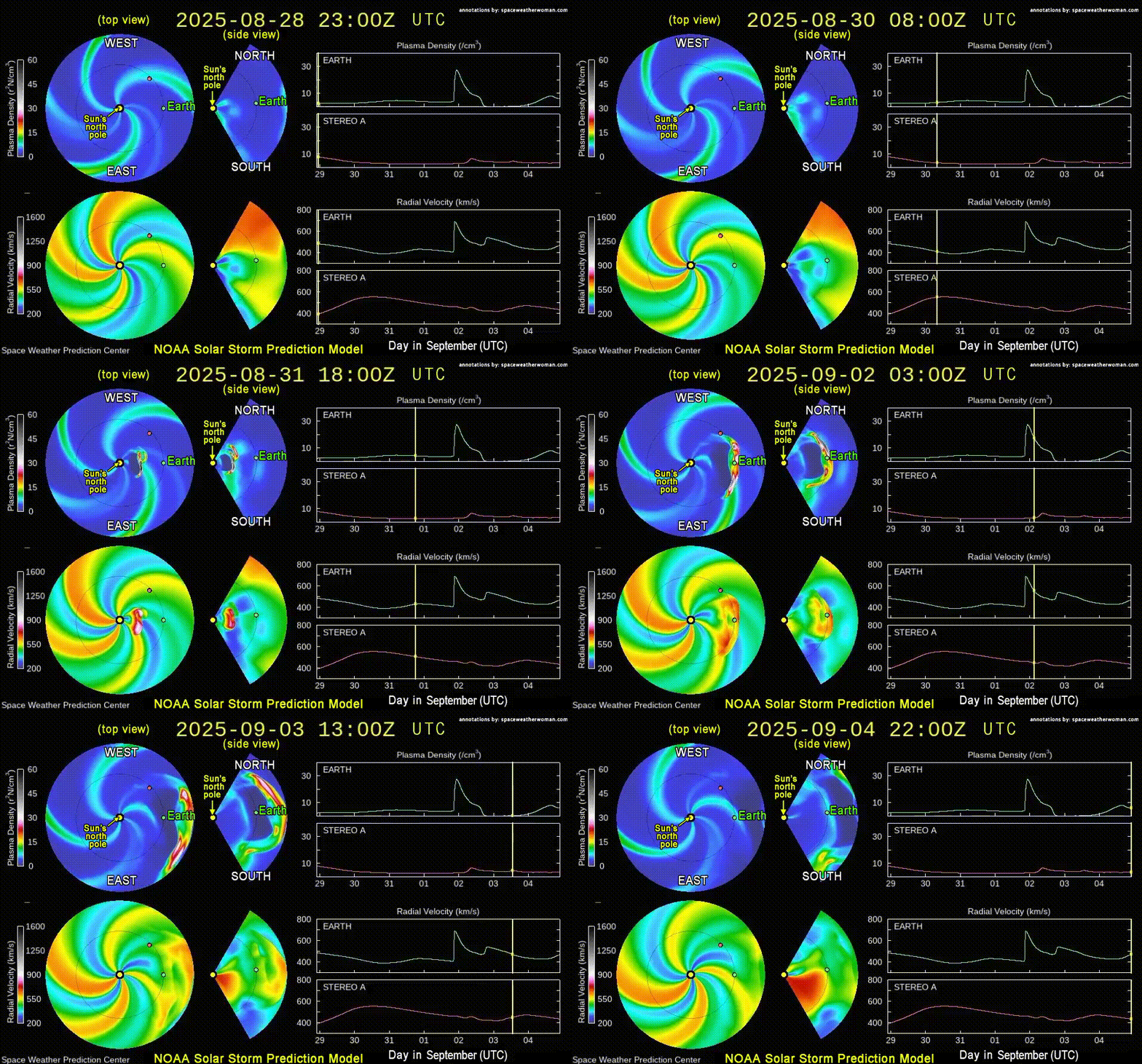
The UK Met Office predicts that the auroral oval will be considerably enhanced following the CME’s arrival, with potential visibility as far south as East Anglia, the Midlands, and Wales, weather permitting. However, a bright moon could hinder skywatching conditions.
According to NOAA, geomagnetic storms are classified from G1 (minor) to G5 (extreme). G3 storms can produce auroras visible at mid-latitudes, including US states like Oregon, Illinois, and New York.
CME events originate from the sun, releasing vast bursts of plasma and magnetic fields that create colorful auroras when they interact with Earth’s magnetic shield. Stronger storms may also disrupt satellites, radio signals, and power systems.
Aurora activity is expected to stay elevated into September 3, offering multiple opportunities to observe the northern lights, even if weather temporarily obscures the view.