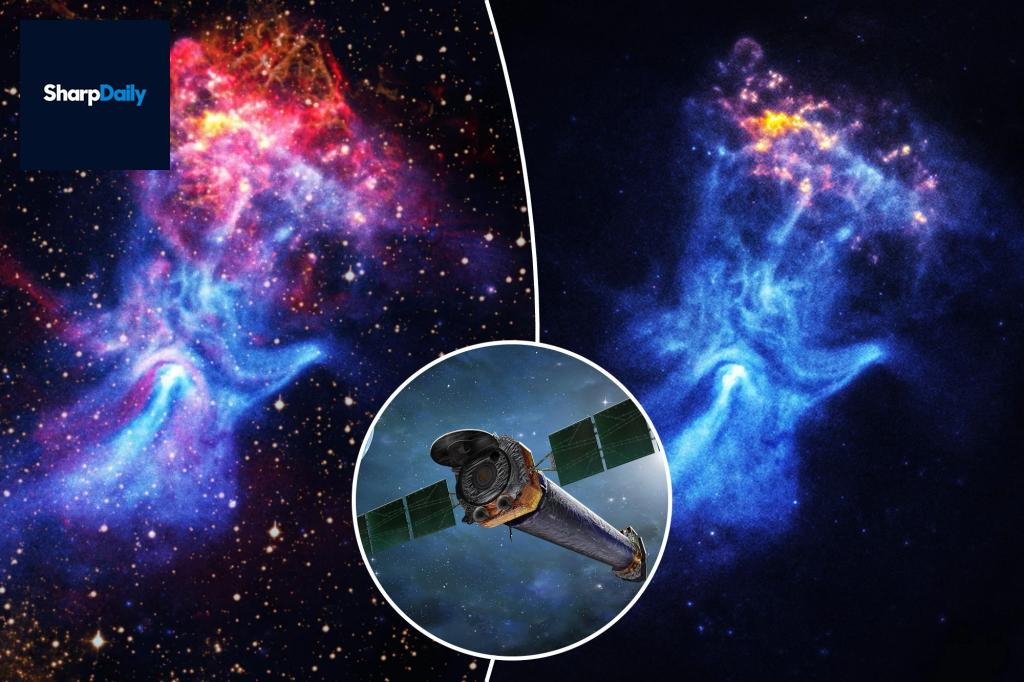
NASA Spots Cosmic Hand Reaching Through 150 Light-Years
Stunning New Image Shows a “Cosmic Hand” Spanning 150 Light-Years
A newly released image reveals a striking “cosmic hand” stretching across 150 light-years, formed by a powerful electromagnetic source in space. This composite combines X-ray data from a space-based observatory with radio observations from a terrestrial telescope array, offering the most detailed view yet of pulsar B1509-58 and its surrounding nebula.
The nebula, dubbed the “cosmic hand,” spans nearly 900 trillion miles, with its core being a neutron star only 12 miles across that spins about seven times each second. Despite its tiny size, this stellar remnant unleashes immense energy, shaping the nebula’s intricate structure through its magnetic field, estimated to be 15 trillion times stronger than Earth’s.

The pulsar formed after its parent star exhausted nuclear fuel, collapsing and exploding as a supernova, which scattered debris into space. The core’s intense spin and magnetic field generate vast quantities of energetic particles, contributing to the nebula’s distinctive appearance. Previous images of this structure date back to 2009, but recent observations reveal previously unseen details.

Radio observations reveal fine filaments that trace the magnetic field lines created as the pulsar’s wind interacts with debris. Interestingly, some features like jets near the pulsar are bright in X-ray emissions but dim or absent in radio, indicating different energetic processes at work.

This research enhances understanding of how highly energetic particles escape shock waves near pulsars and travel along magnetic field lines, creating the glowing structures observed. The surrounding supernova remnant, RCW 89, appears complex, with a patchwork of emissions indicating a dynamic environment. Scientists emphasize that each new observation uncovers fresh surprises about the interactions between pulsars and their remnants.