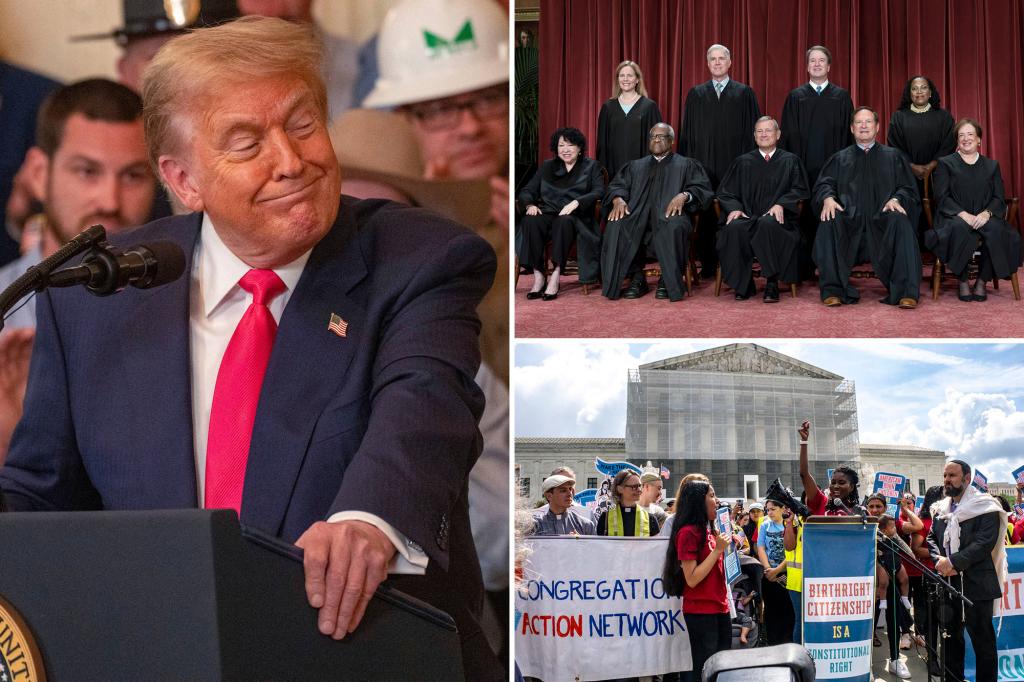
Tr:um:p Scores Major Victory in Birthright Citizenship Case – Supreme Court Limits Nationwide Injunctions!
Supreme Court Limits Lower Courts’ Power to Issue Nationwide Injunctions
The Supreme Court has ruled that lower courts issuing broad injunctions that block federal actions across the country likely exceed their constitutional authority. This decision supports the Trump administration’s efforts to challenge nationwide court orders that prevent certain policies from being implemented.
The case, Trump v. CASA, Inc., focused on whether federal courts can place nationwide bans on executive orders. The court did not evaluate the legality of the policies themselves but clarified that a single district judge cannot indefinitely block a presidential action from taking effect across the entire nation.
Justice Amy Coney Barrett, writing for the majority, emphasized that courts should not exercise control beyond their proper scope and that injunctive relief must be narrowly tailored to address specific issues. Historically, nationwide injunctions have been rarely used and are not supported by the original statutes governing the judiciary.
In response to the ruling, President Trump called it a ‘monumental victory for the Constitution’ and announced plans to proceed with policies previously blocked by courts, including efforts to end birthright citizenship. The decision restricts lower courts from halting executive actions on a broad scale without clear legal justification.
Background on Birthright Citizenship
The case against President Trump’s order was prompted by efforts to end automatic citizenship for children born to illegal immigrants—a practice linked to ‘birth tourism.’ The 14th Amendment guarantees citizenship to those born in the U.S., but Trump argued it no longer applies to certain migrant situations. Several states and immigration groups opposed the order, leading to multiple injunctions by lower courts.
Legal Perspectives and Reactions
While conservative justices expressed concern over judicial overreach, liberal justices warned that limiting courts’ powers could threaten other rights. Justice Sonia Sotomayor dissented publicly, warning that the ruling could weaken protections against arbitrary government actions. Justice Ketanji Brown Jackson criticized the decision as allowing unlawful government conduct, while Justice Alito highlighted the importance of rigorous class-action lawsuits to challenge executive overreach.
The ruling marks a significant shift in how courts can use injunctions to oversee federal policies, underscoring a balance between judicial authority and executive power.