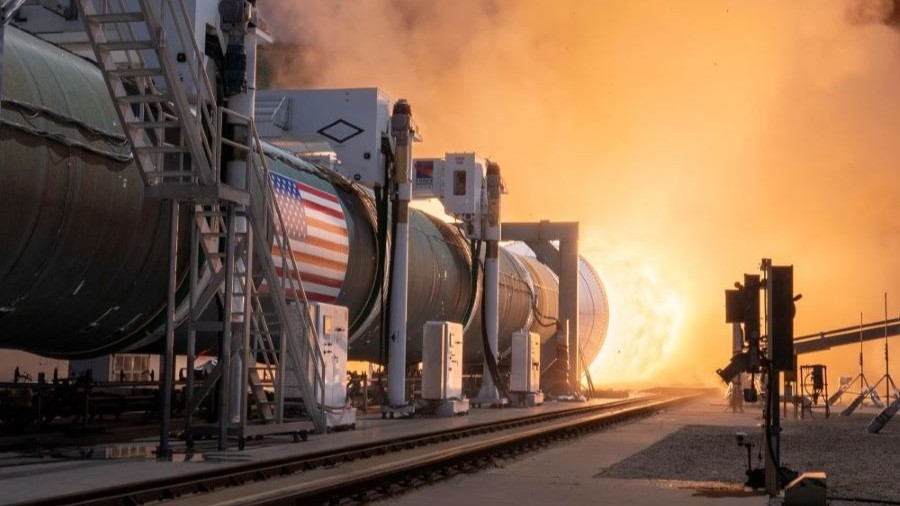
NASA Rocket Booster Nozzle Explodes During Launch Test – Watch the Shocking Explosion!
Test of Upgraded Solid Rocket Booster Ends with Anomaly
An enhanced version of a solid rocket booster used in NASA’s Space Launch System (SLS) encountered an unexpected issue during a recent static test.
The test, conducted at Northrop Grumman’s facility in Promontory, Utah, aimed to evaluate the Booster Obsolescence and Life Extension (BOLE) upgrade—an advanced five-segment booster designed to increase lift capacity for future missions. The demonstration simulated a launch burn lasting approximately two minutes.
As the test reached about 100 seconds, flames erupted from the top of the engine nozzle. Shortly after, a more intense burst of exhaust gases erupted, scattering debris around the test site. Despite the visible anomaly, the test continued and concluded as planned.

One test operator exclaimed, “Whoa,” as the burn progressed, indicating surprise at the anomaly, though no further issues were acknowledged during the test’s remainder.
Jim Kalberer, vice president of propulsion systems at Northrop Grumman, stated, “While the motor performed well under harsh conditions, we observed an anomaly near the end of the test. This valuable data will help us refine future designs.”
The BOLE upgrade enhances the booster with new, specially fabricated parts, carbon fiber casings, and improved propellant efficiency—boosting performance over 10% compared to earlier SLS boosters. The test generated over 4 million pounds of thrust and gathered data from more than 700 points.
However, the deployment of these upgraded engines remains uncertain. NASA’s current budget proposals suggest canceling the SLS after Artemis 3, which could delay or halt the introduction of BOLE engines planned for Artemis 9 and beyond.
For now, the test provides essential insights into the booster’s capabilities and challenges as space agencies prepare for future lunar missions.