The North Korea-Russia alliance gets tighter
TIT FOR TAT — After months of sending troops and weapons to help Russia in its fight against Ukraine, North Korea may finally be getting something crucial in return.

People watch a news program in Seoul, South Korea, showing North Korean soldiers undergoing combat training in Russia on April 30, 2025. | Ahn Young-joon/AP
On Tuesday, South Korean military officials announced that North Korea likely received help from Russia to develop a new air-to-air missile — a missile fired from an aircraft to destroy another aircraft — which is the kind of advanced weaponry that South Korea is attempting to build by 2032.
Just weeks before that, North Korea unveiled suicide attack drones, which the state media claims have been equipped with artificial intelligence. This, too, was likely assisted by Russian technology, according to Lee Sung-joon, spokesperson for the South Korean Joint Chiefs of Staff, who said, “Russia may have had something to do with the internal systems and parts.”
While the details of these weapon developments cannot be 100 percent verified due to the lack of international access to North Korean operations, the apparent advancements are enough to raise real concern about Russia beginning to provide advanced military technology to North Korea. A supercharged North Korea could spell trouble for the U.S., which had relied on a strategy of deterrence — the idea that North Korea kept peace because it knew it would be overmatched in war — to keep Pyongyang away from American allies.
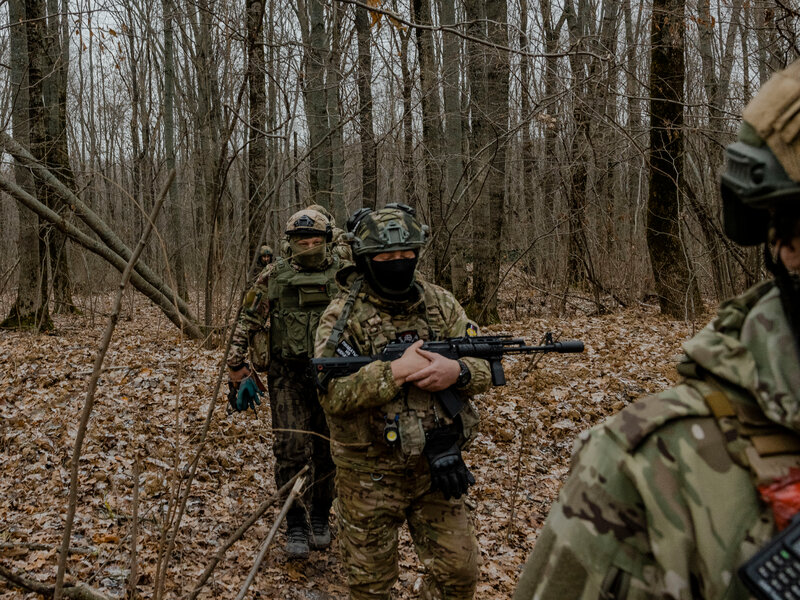
North Korea has been a crucial partner in Russia’s war against Ukraine, supplying a range of weapons from artillery shells to ballistic missiles. One of those missiles was likely used last month to kill 12 people in Kyiv. In addition, North Korea also sent 11,000 of its soldiers to the field last year, bolstering Russia’s dwindling manpower as the war dragged on. About 4,700 of those troops have either been killed or injured, and yet North Korea has sent at least an additional 3,000 soldiers to the battlefield early this year.
Despite multiple reports from South Korea, Ukraine and the U.S. about North Korea’s involvement in the war, neither North Korea nor Russia formally acknowledged the partnership until last month, when North Korean Supreme Leader Kim Jong Un announced he had sent troops to “annihilate and wipe out the Ukrainian neo-Nazi occupiers and liberate the Kursk area in cooperation with the Russian armed forces.” That marks the first formal acknowledgment of a military cooperation between the two countries under Kim Jong Un’s reign.
When North Korea’s support for Russia’s war was first detected, the U.S. and its allies were concerned about how that partnership could destabilize Asia. But the one silver lining was that the relationship was not yet reciprocal where it really mattered: It hadn’t seemed like Russia’s state-of-the-art military technology was being shared with North Korea.
But South Korean officials believe that may no longer be the case — which is a revelation that could not only shatter stability in East Asia but also directly threaten the U.S.
“Let’s say Kim goes to the extreme,” said Bruce Bennett, a senior defense analyst at RAND, “and at some point uses a nuclear weapon. The natural tendency of the U.S. doctrine is if they do that, we will eliminate the regime.” But what North Korea is trying to do, he said, is to “have enough nuclear forces such that if we go after the regime, he goes after the U.S. and allied population centers, and that’s going to deter us.”
“[Kim Jong Un] is trying to build a military capability where he can actually use some of his military for coercive purposes, for some other things he wants, like economic assistance, because he’s doing such a miserable job in economic areas. It’s his one potential way of trying to solve some of those problems,” Bennett added.
The dangers of the North Korea-Russian alliance has been on the U.S. radar for a while: “The DPRK is already receiving Russian military equipment and training. Now, we have reason to believe that Moscow intends to share advanced space and satellite technology with Pyongyang,” then-Secretary of State Antony Blinken during a January visit to Seoul.
The recent developments prove that we’re one step closer to those concerns, if not already there.
What’d I Miss?
— Two Israeli Embassy staffers killed in shooting outside Capital Jewish Museum: Two staff members at the Israeli Embassy were shot and killed Wednesday outside the Capital Jewish Museum by an assailant who police say shouted “free, free Palestine” after he was arrested. The attack outside an event at the Jewish Museum in Washington drew widespread condemnation, including from President Donald Trump. Homeland Security Secretary Kristi Noem said federal authorities were investigating the attack.
— Judge blocks Trump bid to dismantle Department of Education: A federal judge has blocked the Trump administration from firing thousands of workers at the Department of Education, ruling that the announced terminations were a thinly veiled effort to dismantle the entire department without congressional approval. U.S. District Judge Myong Joun rejected the administration’s claim that the thousands of terminations announced in March were a bid for “efficiency.” In fact, they had deeply disrupted services for students, families and states, making processes less efficient, the judge said.
— Deadlocked Supreme Court won’t allow nation’s first public religious charter school: The Supreme Court deadlocked today on whether openly religious schools are entitled under the Constitution to receive public money through state charter-school programs. By splitting 4-4 on the question, the justices left in place a lower-court ruling in Oklahoma denying public funding to what would have been the nation’s first religious public charter school. But the deadlock sets no precedent on the issue to guide officials in the rest of the country — and supporters of religious charter schools promised they would try to bring additional litigation to the high court.
— Trump administration ends Harvard’s ability to enroll foreign students: The Trump administration is halting Harvard University’s eligibility to enroll international students — the latest move in the growing pressure campaign for the university to align itself with the administration. Homeland Security Secretary Kristi Noem notified the university today that their certification for the Student and Exchange Visitor Program is revoked, following an extensive records request from the Department of Homeland Security that Noem alleges Harvard has not complied with. The certification program is what allows institutions to enroll foreign students.
— NOAA projects above-normal Atlantic hurricane season: Federal forecasters today predicted the United States would most likely experience an above-normal Atlantic hurricane season that could yield up to 19 named storms and five major hurricanes. The National Oceanic and Atmospheric Administration projected a 60 percent chance of exceeding the average 14 named storms for the season that runs June 1 through Nov. 30. NOAA officials said reduced trade winds and higher ocean temperatures that provide more fuel for cyclones will boost the likelihood of storms this season. Climate change also has contributed to heavier rainfall events that make hurricanes more destructive, National Weather Service Director Ken Graham said.
AROUND THE WORLD
FURY IN FRANCE — A visibly angry Emmanuel Macron blasted his ministers during a defense cabinet meeting Wednesday after a botched release of a report into the influence of the Muslim Brotherhood in France, according to a high-ranking government official.
A second official, who, like others quoted here, was granted anonymity to speak candidly, said the French president accused his ministers generally for not coming up with adequate solutions to counter the threat posed by the Islamist group. But the dressing down — first reported by French daily Le Parisien — appears to be a shot across the bow to Interior Minister Bruno Retailleau.
The report into the influence of the Muslim Brotherhood was expected to be published on Wednesday, but its release was delayed by Macron’s office after the document was leaked to conservative media. An early version of the report seen by POLITICO said that the Muslim Brotherhood had gone to great lengths to push its fundamentalist agenda across France and Europe.
INTERPRETATION QUESTIONS — Nine European leaders are calling for the European Convention on Human Rights to be reinterpreted to allow migrants who commit crimes to be expelled more easily.
The European Court of Human Rights has extended the scope of the Convention too far, argue the signatories of a written statement spearheaded by Italy’s Prime Minister Giorgia Meloni and Danish PM Mette Frederiksen.
Italy and Denmark want to “open a political debate on some European conventions to which we are bound and on the capacity of those conventions, a few decades after they were written, to address the great issues of our time, starting precisely with the issue of the migration phenomenon,” Meloni said this evening.
Leaders from Austria, Belgium, Czechia, Estonia, Latvia, Lithuania and Poland also signed the document.
RADAR SWEEP
SPREADING AROUND — When indigenous people from Guatemala, Honduras and El Salvador migrate to the United States, many don’t bring more than the clothes on their backs and their native tongues, which derived from ancient Mayan civilizations. Now, Mayan languages are spreading across the country through immigration and being kept alive in immigrant communities. California cities like Oakland have become hubs for Mayan language speakers, some of which host radio programs and teach children in Mam, one of 30-plus Mayan languages spoken around the world. Juan Pablo Pérez-Burgos reports for BBC.
Parting Image
