NPR Executive Maher Experiments with Comedy on PBS: ‘We Are a Nonpartisan News Organization’
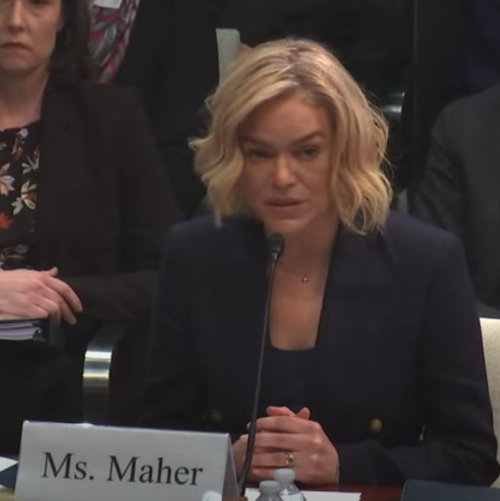
Katherine Maher, president and chief executive of National Public Radio, continued her sympathy tour to save NPR from the Trump administration’s executive order, with a pit stop at NPR’s publicly funded cohort, PBS’s News Hour program. When gently challenged that Trump says NPR lacks viewpoint diversity, she comically claimed: “I first of all, respond by saying we’re a nonpartisan news organization.”
Co-anchor Geoff Bennett interviewed Maher on Tuesday’s edition, where he explained that NPR’s lawsuit, joined by three public radio stations in Colorado, “contends the president’s order is a violation of the First Amendment.” Bennett read a PBS statement relaying that the network hasn’t joined NPR’s lawsuit but may take legal action in the future, then asked Maher, “What’s the case that you’re making against the Trump White House?”
Maher laid out NPR’s case, leading with her chin by leaning on that bogus First Amendment argument.
Katherine Maher: Well, it’s interesting because the executive order is very specific, in that it accuses NPR and PBS of not airing fair or unbiased news. And so it is a textbook example of viewpoint discrimination from a First Amendment standpoint. Essentially, by blocking funding to NPR and PBS, it is a form of retaliation against our organizations for airing editorial programming that the president might disagree with. The safeguards for our editorial independence go very far back. They go back to the Public Broadcasting Act. It was one of Congress’ sort of paramount objectives was to ensure that public media was independent from government influence. And so you have the editorial safeguards that should exist for our organizations….
The Public Broadcasting Act also mandates “strict adherence to objectivity and balance in all programs or series of programs of a controversial nature,” which both NPR and PBS are clearly failing to provide. And, as Dan McLaughlin explained at National Review Online, “There is no First Amendment right for media organizations to be on the public payroll in the first place.”
Bennett retained PBS’s modus operandi for soft guest questioning of those they sympathize with, the “how do you respond to that?” template. At least his questions to Maher were somewhat more pointed than the puffballs his News Hour co-anchor Amna Nawaz tossed to PBS’s own chief executive, Paula Kerger, in an interview that aired April 29, days before Trump’s Executive Order. (Though Bennett could have prodded Maher about her capability of objectivity, given her woke, often goofy Twitter history and Democratic donations.)
Geoff Bennett: The White House and some Republicans in Congress, as you well know, have accused NPR of promoting a liberal bias. Beyond that, the former NPR editor Uri Berliner, he accused the network of having what he called a lack of viewpoint diversity. How do you respond to those critiques?
Katherine Maher: Well, I first of all, respond by saying we’re a nonpartisan news organization. We seek to be able to provide a range of different viewpoints in terms of who we bring on air, the stories that we tell….My view is that that is a mischaracterization of our work. We do not seek to favor any political party at all. We seek to ensure that Americans have a wide range of perspectives available to them.
NewsBusters disproves the “nonpartisan” NPR thesis several times a week. Then came the “news desert” talking point:
Bennett: There’s also this argument that, with the proliferation of news and media outlets these days, there’s no real reason, there’s no real need for the federal government to be in the business of funding NPR and PBS. There’s so many options out there, even in rural areas that might be less served. How do you respond to that?
Maher: Well, it’s simply not true. Twenty percent of Americans today do not have access to a local newspaper or source of news other than public media. There has been a significant contraction in local news across the country….
Liberal groups like the Pew Research Center have reported on the decline in local newspapers. But that’s in part because consumers have stopped buying them. Last May, Pew found only 15 percent of Americans are paying to get local news….and only nine percent said they turn to “radio” for local news. NPR’s CEO doesn’t have to prove that rural areas are actually getting local news from an NPR station.
This biased PBS segment was funded in part by viewers like you.