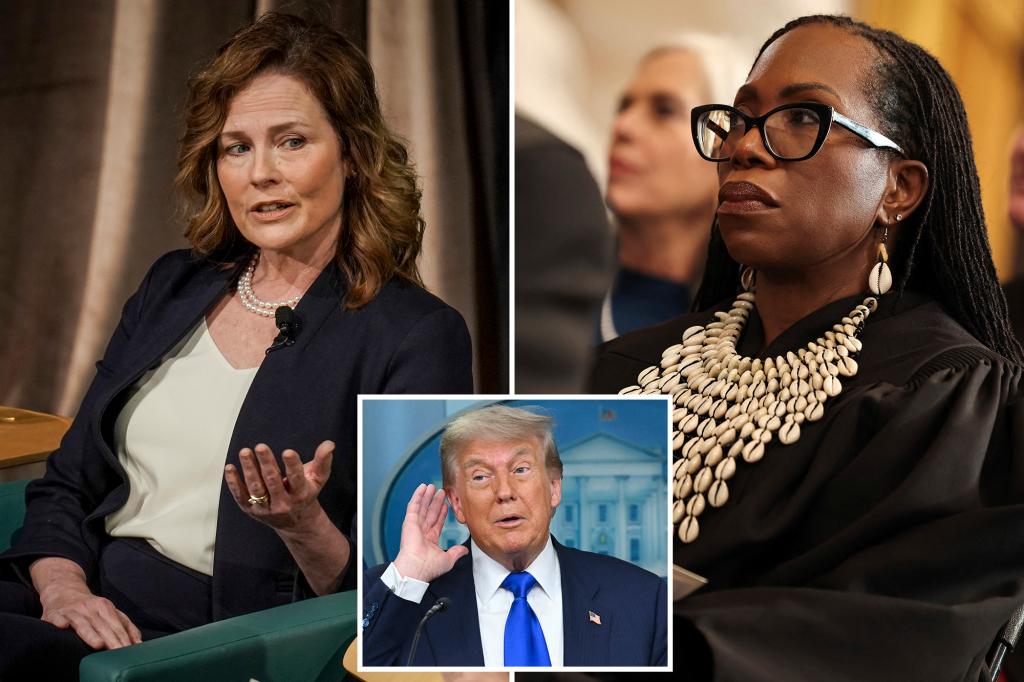
Amy Coney Barrett Unleashes Shocking Blow Against Ketanji Brown Jackson in Birthright Citizenship Battle!
Supreme Court Justice Amy Coney Barrett Criticizes Colleague’s Dissent
Justice Amy Coney Barrett recently sharply rebuked Justice Ketanji Brown Jackson’s dissent in a landmark case concerning birthright citizenship, where the Supreme Court limited lower courts’ ability to issue universal injunctions. Barrett, author of the majority opinion, dismissed Jackson’s argument as fundamentally flawed and conflicting with over two centuries of legal precedent and constitutional principles.
Barrett accused Jackson of criticizing executive power while endorsing judicial authority to an excessive degree, stating, “Justice Jackson decries an imperial Executive while embracing an imperial Judiciary.” She further commented on Jackson’s legal reasoning, mocking her for referring to statutory analysis as “boring ‘legalese,” and argued that the core question should be whether courts can order the Executive to comply with the law—an issue Jackson dismissed as inconsequential.
While Barrett expressed some moderate praise for Justice Sonia Sotomayor’s focus on traditional legal sources, she strongly criticized Jackson’s approach, describing it as “a startling line of attack that is not tethered to any doctrine whatsoever.” Barrett suggested Jackson’s view of judicial power would be alarming even to staunch advocates of judicial supremacy.
Jackson’s dissent leaned heavily on practical concerns, warning that unchecked executive power could eventually threaten the constitutional republic, and lamenting that the ruling failed to consider the broader implications of judicial constraints on the government’s authority. Notably, Jackson ended her opinion without the usual formal dissent phrases, signaling her frustration with her colleagues’ decision.
The case involved Trump’s attempt to redefine birthright citizenship, a move that lower courts previously stayed because they found it likely unconstitutional. The Supreme Court, however, only addressed the procedural question of courts’ authority to block executive orders, without ruling on the legality of Trump’s actions.
Commentators observed that Barrett’s pointed critique and her marked disagreement with Jackson reveal tensions within the court, suggesting that Jackson may have alienated some colleagues with her dissenting tone. The scene marked the end of the Court’s term, and stark differences in judicial philosophy remain evident.