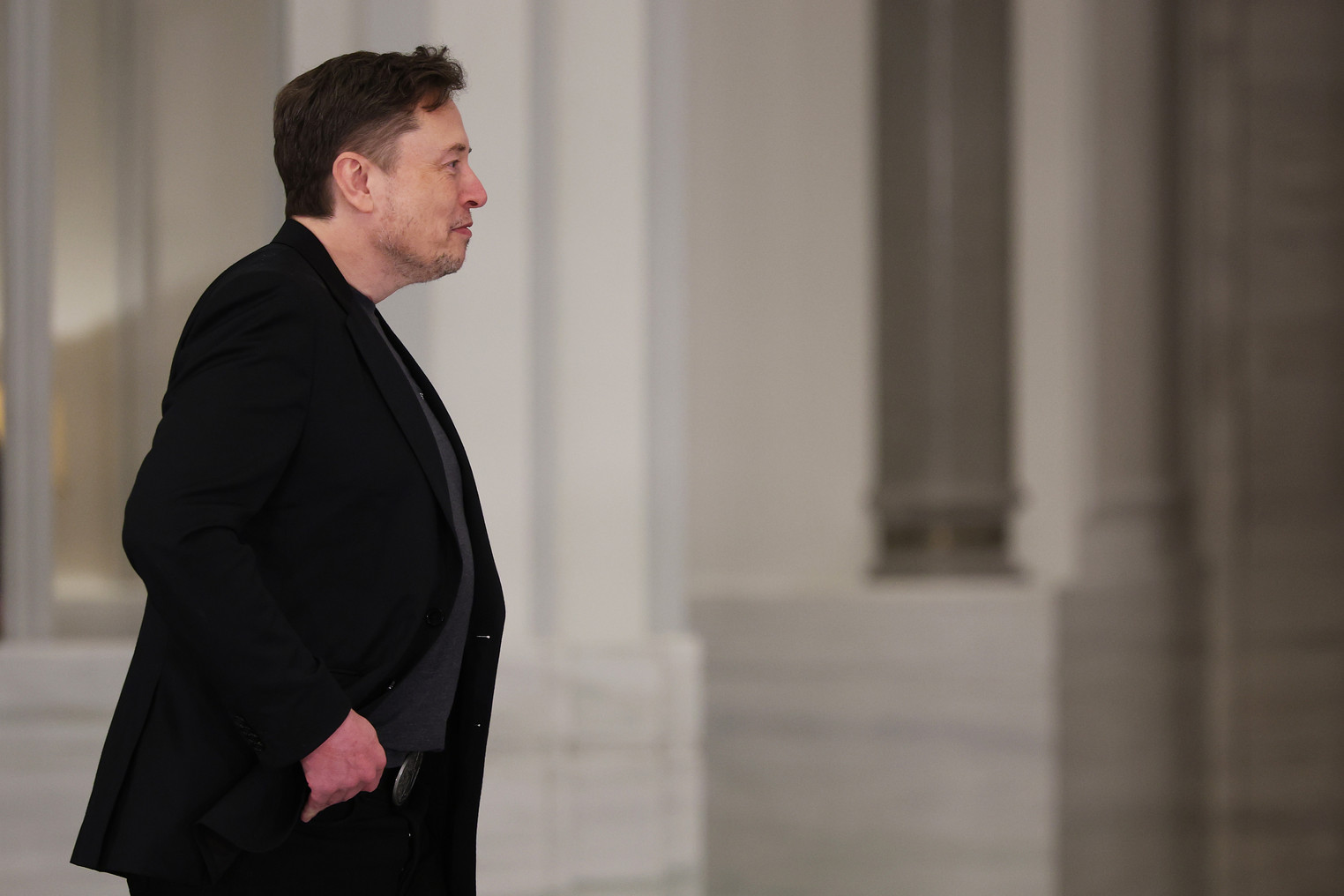
How Washington broke Elon Musk
SWAMP RULES — In the beginning, the future looked bright for Elon Musk.
The world’s richest man barrelled into Washington fresh off a decisive win for President Donald Trump, on whose campaign he’d spent nearly $300 million. They’d swept the swing states and won the popular vote — and Musk, long X’s “troll in chief,” had taken his “lib owning” all the way to the White House.
“I am become meme,” the billionaire said in February at the Conservative Political Action Conference, grinning behind mirrored sunglasses and a “dark MAGA” hat. On the stage, he revved a chainsaw — a symbol for his government slashing — as the crowd roared.
But Musk was a creature of Silicon Valley, a scion of the “PayPal mafia” whose leadership and willingness to take big risks propelled him to unparalleled wealth and influence.
Washington, he would soon discover, was an entirely different beast. And in the end, it proved too unwieldy for Musk to truly leave his mark. He was a man used to “breaking things” in order to put them back together in his own image. But the fiefdoms of Trump’s Washington proved shatter-resistant, sending the world’s richest man scrambling back to his other ventures.
He sowed the seeds of his own demise on Inauguration Day. Musk, speaking at a Trump rally about his excitement for the next four years, gleefully made a straight-arm salute — a split-second gesture immortalized in the press and on social media. Critics called it a Nazi salute, a comparison bolstered by his ardent support for Germany’s far-right AfD political party.
Musk was discouraged by this interpretation, but attempted to brush it off with a wink. “I did not see it coming,” he told the conservative podcaster Joe Rogan in February, pronouncing “not see” like “Nazi.”
In the same interview, Musk told Rogan he’d received death threats, a problem he’s touched on repeatedly since then. “They actually want to kill me,” he said. Those concerns only intensified amid a string of attacks on Tesla vehicles — including a man who blew up a Cybertruck outside a Trump property in Las Vegas — which the Justice Department is investigating as acts of domestic terrorism.
Still, things in Washington went relatively well for Musk at first. The members of his secretive DOGE team had fanned out across the federal government, shuttering agencies and publicizing overblown but provocative examples of “waste, fraud and abuse” — including allegations that the U.S. had spent $50 million on condoms for Gaza and that the Social Security Administration was rampantly sending checks to dead people (both claims have been debunked). Musk attended and spoke at Trump’s first Cabinet meetings, earning applause from Cabinet secretaries. He frequented Mar-a-Lago and the Oval Office, and had his own space in the Eisenhower Executive Office Building next to the White House.
Behind the scenes, though, Musk was clashing with some of the Cabinet secretaries whose agencies he was hellbent on hollowing. Reports of tense and sometimes profane interactions between Musk and other top administration officials, including Secretary of State Marco Rubio and Treasury Secretary Scott Bessent, began to surface in news reports. And Musk and Peter Navarro, Trump’s trade guru, publicly sparred over Musk’s disagreement with Trump’s sprawling tariff regime.
As DOGE sowed chaos across Washington, Democrats seized on Musk as the key boogeyman in their anti-Trump messaging. He was an unelected and unconfirmed “oligarch” wielding unprecedented and unparalleled power, they argued. DOGE, they said, wasn’t rooting out “waste, fraud and abuse.” It was terrorizing civil servants, slashing benefits to the most vulnerable Americans and causing irreparable damage to America’s international reputation.
That strategy appears to have worked. Musk’s favorability has consistently polled underwater, and deep below Trump’s. In heated town hall moments that quickly went viral, constituents in red congressional districts slammed Republican members of Congress for allowing Musk’s power to grow with such little oversight. The biggest blow came in April, when a Wisconsin Supreme Court candidate — to whom Musk had funneled $20 million — suffered a crushing defeat to his Democratic-backed rival, who had framed the election as a referendum on Musk. By then, it was clear that many Republicans began viewing him as a political liability.
The billionaire’s fortunes turned outside of government, too. Tesla sales and stock prices began to tumble, at least in part because of a global boycott. In late April, the company reported that its revenue had dipped 20 percent since Trump took office, and net income fell a staggering 71 percent. Musk promised his shareholders he would reduce his time on DOGE to refocus on Tesla.
Musk had initially projected that DOGE would be able to cut $2 trillion in government spending, a figure he would later slash to $1 trillion. DOGE now says it has cut about $175 billion — less than 10 percent of Musk’s initial expectation. Outside analysts have found that government spending has actually increased this year.
The billionaire grew increasingly frustrated. He was still following the Silicon Valley playbook, where CEOs had total control over their chiefdoms and rulebreaking was called “innovation.” But Washington was a different world, rife with checks and balances and politicking that couldn’t be solved with a debugger, or mass terminations, or a tweet.
He began to retreat from the spotlight.
Last week, Musk said he would be taking a step back from donating to GOP political candidates, shocking Republicans who had come to see him as the source of almost unlimited campaign cash. On Tuesday morning, the break was complete: CBS News aired a clip of Musk bashing the GOP’s “big, beautiful bill,” saying he was “disappointed” by Trump’s landmark legislation, which he said would undermine DOGE’s spending cuts. Later that day, he watched his SpaceX rocket, Starship, tumble out of control.
The next day, Musk confirmed he would be letting his DOGE run free.
“As my scheduled time as a Special Government Employee comes to an end, I would like to thank President [Trump] for the opportunity to reduce wasteful spending,” Musk said on X, referring to his executive branch designation that caps government work at 130 days per year. Assuming Musk worked every day since Inauguration Day, that deadline comes Friday.
“The @DOGE mission will only strengthen over time as it becomes a way of life throughout the government,” Musk added.
Trump has yet to publicly discuss the departure.
A DOGE spokesperson did not respond to a request for comment.
Welcome to POLITICO Nightly. Reach out with news, tips and ideas at [email protected]. Or contact tonight’s author at [email protected] or on X (formerly known as Twitter) at @iriesentner.
A fresh chapter for Playbook—powered by bold reporting and unrivaled access. Jack Blanchard leads with clear-eyed analysis on Trump’s second term. Dasha Burns brings exclusive White House scoops as one of the most sourced Trump reporters in D.C. Adam Wren writes the must-read political storytelling every weekend. Sign up nowto read what Washington’s power players use to drive their day.
What’d I Miss?
— Court rulings jolt Trump trade talks: Three federal court decisions in the last 24 hours have injected fresh uncertainty into President Donald Trump’s negotiations with the nation’s largest trading partners. Some foreign officials say it may be to their benefit as they continue tariff talks with the U.S. The Trump administration has for months projected confidence on the world stage — both slapping down and backing away from tariffs at will — and watched as countries scrambled to respond. For the first time, the courts’ decisions have put Trump on the back foot as his administration grapples with how to respond to a major setback of its sweeping trade agenda, and some countries see the rulings as a release valve for tense, and sometimes stagnating, negotiations with the U.S.
— Judge extends block on Trump’s bid to boot Harvard’s foreign students: A federal judge today extended her block on the Trump administration’s bid to prevent Harvard University from enrolling foreign students. U.S. District Judge Allison Burroughs announced her plan during a court hearing shortly after the administration revealed that it would give the university a 30-day reprieve before canceling its authority to admit students from abroad. That reprieve does not eliminate the need for a court order barring the administration from taking action against Harvard, Burroughs said.
— Rubio outlines plans to drastically cut human rights offices in State: Secretary of State Marco Rubio plans to gut the State Department’s human rights bureau as part of a sweeping reorganization of the country’s diplomatic service, according to internal department documents and people familiar with the plans. The State Department sent a document to Congress today notifying lawmakers of the changes that call for the elimination of most offices in the Bureau of Democracy, Human Rights and Labor — or DRL as it’s known in the diplomatic corps. That would lead to funding freezes or cuts on programs ranging from internet freedom initiatives in autocratic countries to support for pro-democracy civil society groups facing repression in sub-Saharan Africa.
— Fed’s Powell tells Trump that rate moves are guided by ‘non-political analysis’: Federal Reserve Chair Jerome Powell and President Donald Trump met at the White House today for the first time in the president’s second term, following recent comments from Trump voicing frustration that Powell hasn’t cut interest rates. The central bank said in a statement that the two men discussed the economy and emphasized that Powell made no commitments on the trajectory for rates, “except to stress that the path of policy will depend entirely on incoming economic information and what that means for the outlook.”
AROUND THE WORLD

RULE OF LAW ‘ON THE BALLOT’ — Poland’s halting effort to restore the rule of law and fully return to the EU mainstream will be decided in Sunday’s presidential vote.
Liberal Warsaw Mayor Rafał Trzaskowski, backed by Prime Minister Donald Tusk, is neck-and-neck with right-winger Karol Nawrocki, supported by the populist-nationalist Law and Justice (PiS) opposition party.
If Trzaskowski wins, he promises to speed up efforts to restore the rule of law, currently stalled by PiS-aligned incumbent President Andrzej Duda. But a Nawrocki victory would block Tusk’s government for the remainder of its term.
Sunday’s outcome means either a clean break with Poland’s past as one of the bad boys of the EU, or a return to a more turbulent relationship with Brussels. When PiS was in power from 2015 to 2023, Warsaw tangled with the EU over its tough abortion laws, freedom of speech, clampdowns on LGBTQ+ rights, corruption, and backsliding on the rule of law.
TARIFF TENSION — Japanese Prime Minister Shigeru Ishiba expressed determination today to defend rules-based, free and multilateral trade systems and work on expanding the main Asia-Pacific trade group at a time of tension over U.S. tariffs, The Associated Press reports.
“High tariffs will not bring economic prosperity,” Ishiba told a global forum in Tokyo. “A prosperity built on sacrifices by someone or another country will not make a strong economy.” Japan seeks to work with the U.S. on investment, job creation and manufacturing high quality products for the prosperity of America and the rest of the world, he said.
His comment comes as Japan’s chief tariff negotiator Ryosei Akazawa travels to Washington, D.C., for a fourth round of talks aiming to convince the U.S. to drop all recent tariff measures. So far Japan has not been successful in gaining U.S. concessions and is reportedly considering purchases of more U.S. farm products and defense equipment as bargaining chips.
Policy moves fast—stay ahead with POLITICO’s Policy Intelligence Assistant. Effortlessly search POLITICO’s archive of 1M+ news articles, analysis documents, and legislative text. Track legislation, showcase your impact, and generate custom reports in seconds. Designed for POLITICO Pro subscribers, this tool helps you make faster, smarter decisions. Start exploring now.
Nightly Number
0.2 percent
How much the United States economy shrunk at an annual pace from January through March, the first drop in three years, the government said today in a slight upgrade of its initial estimate.
RADAR SWEEP
BOX OFFICE BUZZ — The 2024-25 Broadway season just became the highest grossing in history, with its $1.89 billion surpassing the 2018-19 season’s $1.82 billion. It’s a fascinating number in the wake of other more popular entertainment options — movies and television — dealing with tumultuous times. Ironically, though, those two things might be related. This year on Broadway featured multiple buzzy productions with bona fide stars from film and TV like George Clooney and Kieran Culkin. As big checks from filmed entertainment become less secure, some of the people who made their bones in front of a camera are now going live in front of an audience. Jesse Hassenger reports for The Guardian.
Parting Image
