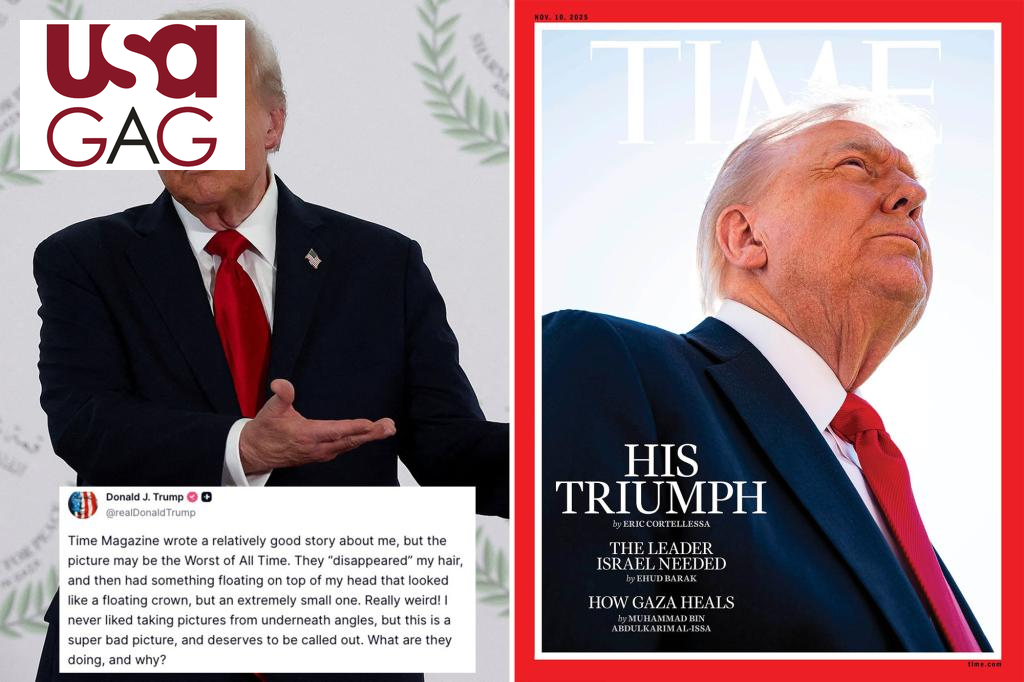
Trump Slams Time for Using ‘Worst Photo’ on Cover Praising His Peace Deal
Trump Criticizes Unflattering Time Magazine Cover
Former President Donald Trump publicly condemned Time magazine for featuring an unflattering photo of him on the cover of a story about the recent release of Israeli hostages from Hamas captivity. He described the image as the “worst photo of all time,” criticizing how his hair was edited and how a small crown-like feature appeared floating above his head.
The cover displayed a close-up portrait from below, highlighting Trump’s right ear, cheek, eye, and nostril, with the headline “His Triumph.” Trump took to Truth Social to express his displeasure, questioning why such a photograph was chosen and suggesting it was intentionally unflattering.

“I normally don’t like photos from underneath angles, but this one is especially bad and needs to be called out,” he remarked. He concluded his comment with a question: “What are they doing, and why?”
The controversial cover appeared a day after 20 hostages, held for over two years, were freed. In exchange, Israel released approximately 2,000 Palestinian prisoners and recovered the remains of around 360 Palestinians.
In the storyline, it was noted that the release of Israeli hostages in Gaza was part of Trump’s diplomatic efforts, potentially marking a significant achievement of his second term and a strategic shift in Middle Eastern affairs. Trump had previously outlined a 20-point plan to resolve the Israel-Hamas conflict, and a ceasefire took effect shortly before the photo controversy.
During recent visits, Trump received a hero’s welcome in Israel and participated in a peace summit in Egypt, where leaders from over twenty nations discussed maintaining the truce.  He emphasized that the peace deal was a remarkable achievement, stating, “We’ve achieved what everybody said was impossible — peace in the Middle East.”
Throughout his career, Trump has shown interest in symbols of prestige, including winning Time’s “Person of the Year” award twice. He has also publicly complained about unfavorable portrayals of himself, often emphasizing the importance of a strong, authoritative image.