Hidden 200-Light-Year Cloud Feeds Our Galaxy’s Center!
Massive Gas Cloud Discovered in Uncharted Region of the Milky Way
A groundbreaking discovery has revealed a sprawling cloud of gas and dust extending approximately 200 light-years in a largely unexplored part of our galaxy.
This structure, dubbed the Midpoint cloud, is classified as a Giant Molecular Cloud. It was identified using the Green Bank Telescope, which unveiled several active regions within the cloud, including zones primed for star formation and dense lanes of material funneling toward the galaxy’s core.
“No one was aware of this cloud until we observed this specific region and detected the dense gas,” explained team leader Natalie Butterfield from the National Radio Astronomy Observatory. “Our measurements of its size, mass, and density confirmed its status as a significant molecular cloud.”
The active sectors and dust lanes suggest a dynamic process of material flowing from the disk of the Milky Way towards its center. Butterfield added, “These hidden rivers of gas and dust serve as channels delivering material inward, offering a unique glimpse into the early stages of gas migration before it accumulates at the galactic core.”
The gas in the Midpoint cloud is in a turbulent condition, reflecting similar chaotic states observed near the galaxy’s center. This turbulence could result from the flow of material along dust lanes or interactions with other molecular clouds.
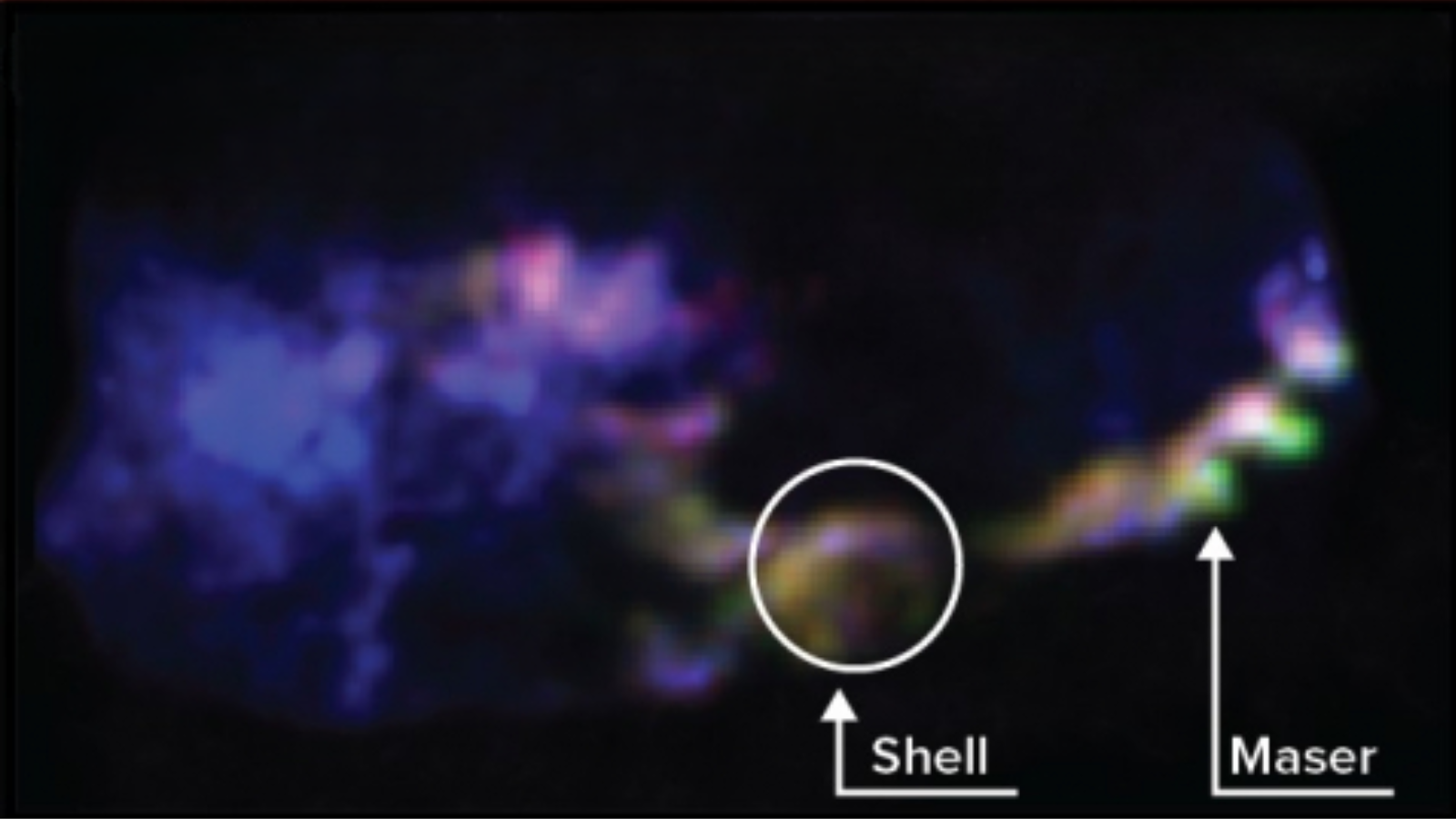
Within the cloud, astronomers identified dense pockets of gas and dust, some of which appear to be on the verge of collapsing into new stars. One such clump, termed Knot E, is a small yet dense gas pocket being eroded by nearby stellar radiation—a phenomenon known as free-floating evaporating gas globules (frEGGs).
Additionally, the team detected a new intense microwave source called a maser, which indicates vigorous star-forming activity within the cloud. They also observed a shell-like structure, likely resulting from a supernova explosion of a massive star.
This discovery sheds light on how matter is transported from the disk to the galaxy’s nucleus, fueling star formation in the dense central region. Unlike some areas where forces inhibit star birth, the leading edges of galactic bars, such as where the Midpoint cloud resides, can accumulate dense gas and stimulate star formation, offering insights into galactic evolution.
The findings are published in The Astrophysical Journal.